
Every business that touches vehicles — lenders, insurers, fleet operators, logistics companies, ride-hailing platforms — has to verify Registration Certificates at some point in their workflow. The question is not whether to verify. The question is how.
For years, manual document review was the only option. Today, RC Verification APIs have made that approach look slow, expensive, and unnecessarily risky. This article breaks down exactly why — across speed, accuracy, fraud risk, cost, and scale — with no ambiguity about which approach wins at volume.
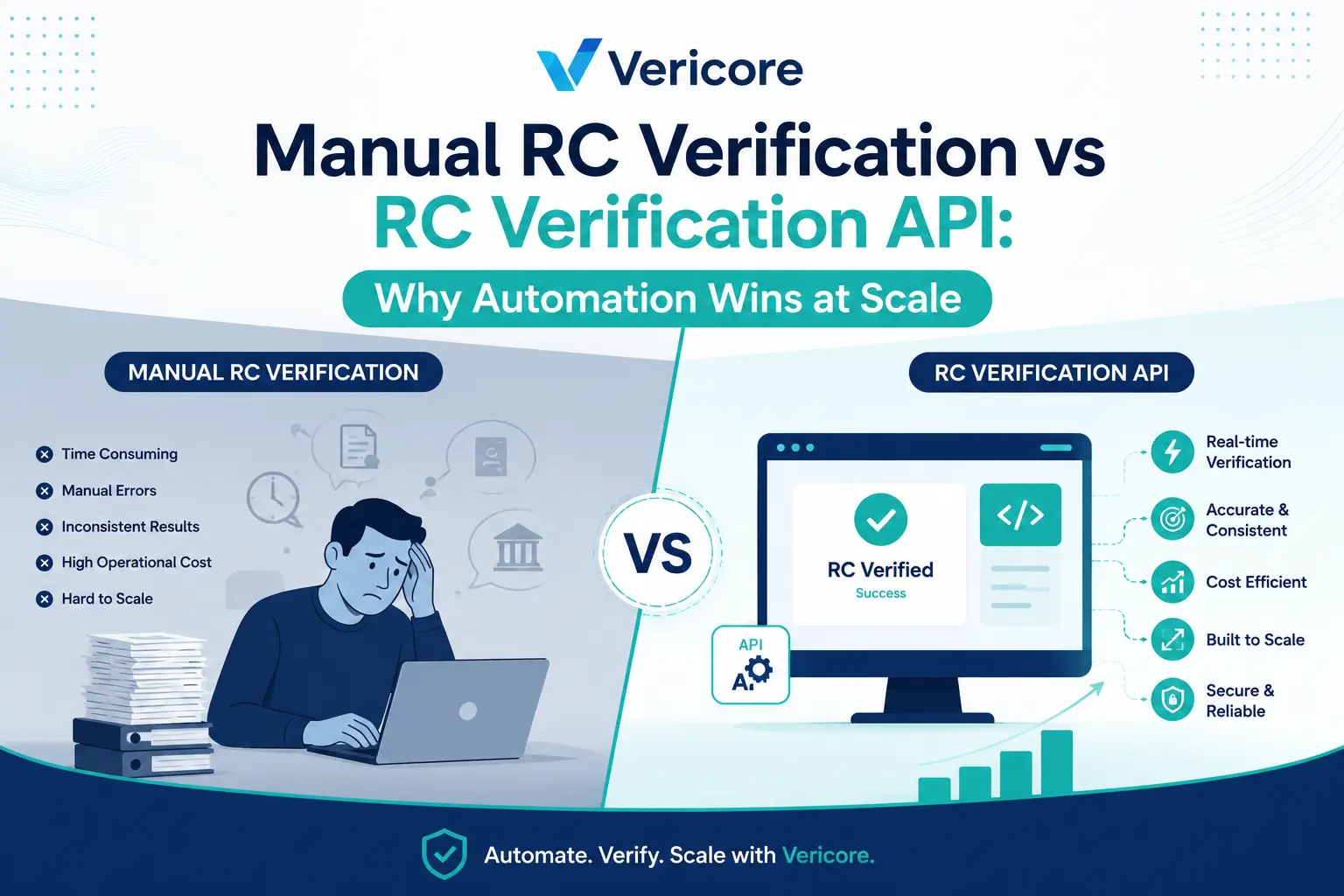
Manual verification is not just slow. It carries compounding costs that most teams underestimate until volume grows.
Time Cost
Each manual RC check takes anywhere from five to twenty minutes, depending on document quality and the agent’s familiarity with the process. Add queue time — the gap between when a document is submitted and when an agent picks it up — and the real turnaround time is often measured in hours, not minutes.
For businesses where RC verification sits on the critical path of a loan approval, insurance issuance, or driver onboarding, every hour of verification delay is an hour of revenue delayed.
Human Error
Agents reviewing hundreds of documents a day make mistakes. Names are misread. Validity dates are misinterpreted. Hypothecation entries — small text in a specific RC field — get overlooked. Vehicle class codes that look similar are confused.
These errors don’t just slow things down. They create compliance gaps. A vehicle whose RC has lapsed gets approved because an agent misread the expiry date. A vehicle already under a loan gets financed again because the hypothecation field was missed.
No Defence Against Tampered Documents
This is the most significant vulnerability of manual RC verification, and the one that costs businesses the most.
An agent reviewing a photo or PDF of an RC can only see what the document shows. If a borrower has altered the owner name, changed the validity date, removed hypothecation details, or fabricated a registration number entirely — the agent has no independent way to detect it unless the alteration is obvious.
At scale, even a small percentage of tampered documents translates into significant fraud exposure.
Headcount Dependency
Manual verification scales with headcount. Double the verification volume, and you roughly need to double the team. That means recruitment, training, management, and the ongoing risk that experienced agents leave and take institutional knowledge with them.
Headcount-dependent operations also struggle with peaks. A product launch, a seasonal surge, or a new partnership can overwhelm a verification team overnight — creating backlogs that affect customer experience across the board.
An RC Verification API removes the document from the equation entirely.
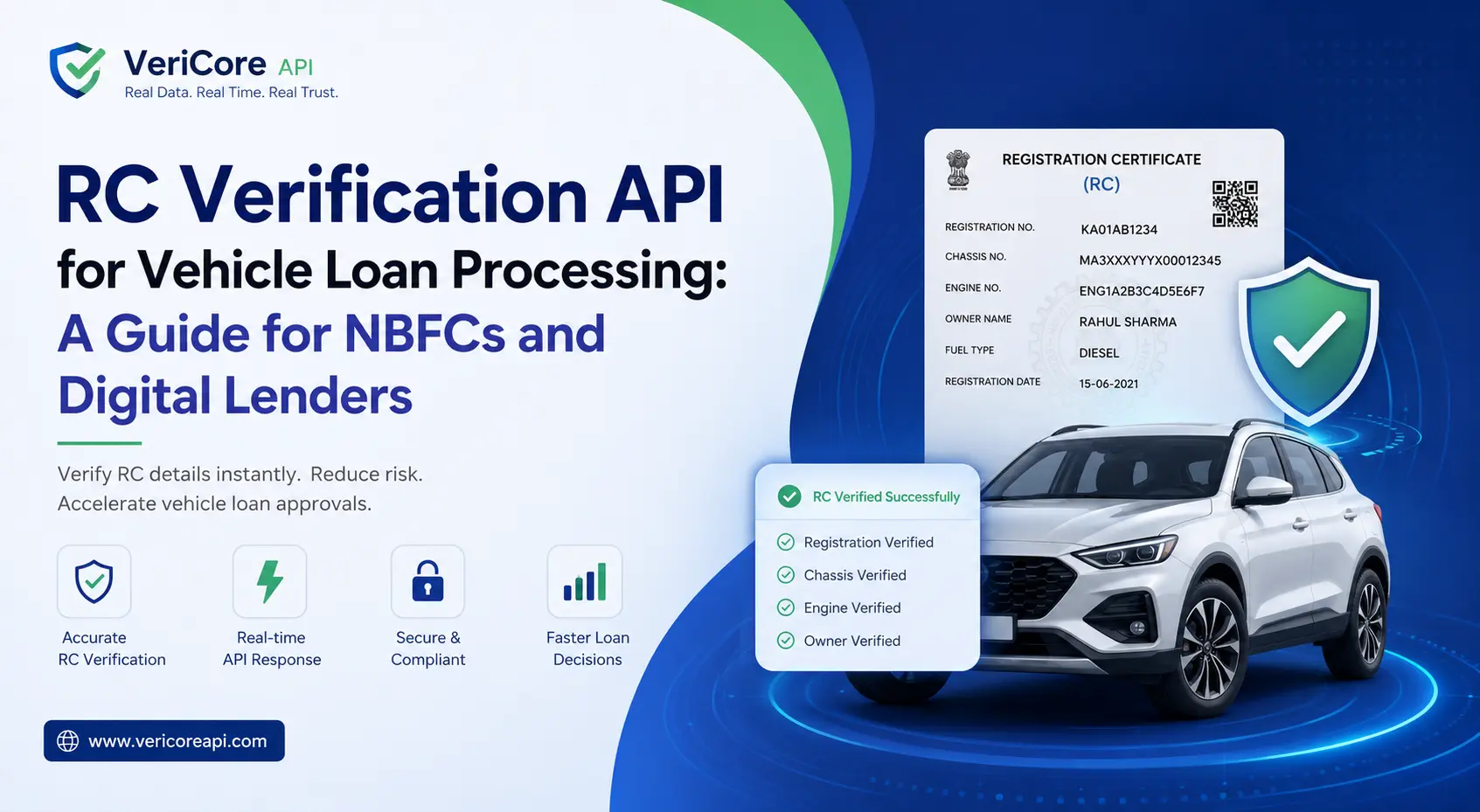
Instead of asking a customer to upload an RC, your system sends the vehicle registration number to the API. The API retrieves the corresponding RC record directly from authoritative vehicle registration databases and returns verified, structured data — in JSON format — within seconds.
There is no document review. No queue. No agent. No dependency on the quality of a photograph.
The data that comes back reflects what the official record actually says — not what a customer-submitted document claims.
| Factor | Manual Verification | RC Verification API |
|---|---|---|
| Verification Speed | 5–20 minutes per check (plus queue time) | Under 3 seconds |
| Throughput | Limited by team size | Thousands of verifications per day |
| Document Dependency | Requires customer to submit RC copy | No document needed |
| Accuracy | Variable — dependent on agent and document quality | High — data sourced directly from official records |
| Fraud Detection | Cannot detect tampered documents | Bypasses uploaded documents entirely |
| Hypothecation Check | Missed if field is obscured or altered | Returned directly from source database |
| Scalability | Requires hiring as volume grows | Scales instantly with no added cost per check |
| Cost Per Verification | High — includes agent time, management overhead | Per-API-call pricing, lower at volume |
| Audit Trail | Manual logs, inconsistent | Automatic timestamped log per check |
| Customer Experience | Upload friction, wait time, follow-up requests | Seamless — happens in the background |
| Error Rate | Human error in reading and data entry | Structured JSON — no re-keying or misreading |
| Peak Handling | Backlogs during surge periods | No throughput ceiling |
Automation wins at scale — but it does not eliminate human judgment entirely.
There are scenarios where an RC Verification API returns a result that requires human review:
In these cases, the API narrows the review queue dramatically. Instead of every document going to a human, only exceptions do. Your verification team shifts from a data entry function to a genuine exception-handling function — a much better use of their time and judgment.
The right operating model is not manual or API — it is API-first, with human review for flagged cases only.
This deserves its own section, because the fraud risk differential between manual and API-based verification is not linear — it compounds with volume.
At ten verifications a day, a single experienced agent catches most obvious fraud attempts. At five hundred verifications a day, no team can maintain that level of scrutiny across every document. Review fatigue sets in. Edge cases get waved through. The fraud rate that was acceptable at low volume becomes material at high volume.
An RC Verification API does not experience review fatigue. Every check runs with identical thoroughness — whether it is the first verification of the day or the ten-thousandth.
Because the data comes from the source database rather than a borrower-submitted document, document tampering — the most common form of RC fraud — has no effect on the outcome. A borrower can submit a perfectly fabricated RC image and the API will return what the actual record says.
For NBFCs, insurers, and fleet platforms processing high volumes, this is the decisive argument for API-based verification: the fraud protection does not degrade as volume increases.
The cost of manual RC verification is often understated because it is distributed across salaries, management time, error correction, and fraud losses rather than appearing as a single line item.
A rough breakdown for a team processing 500 RC verifications per day:
Manual verification:
RC Verification API:
The crossover point — where API-based verification becomes cheaper per check than manual review — is typically reached within the first few months of operation at moderate volumes.
Moving from manual RC verification to an API-based process does not require a complete system rebuild. Most integrations follow this path:
Step 1 — Identify the verification trigger point
Where in your workflow does RC verification happen today? Application intake, underwriting, disbursal? Map the current manual step and identify what data is collected at that point.
Step 2 — Integrate via REST API
RC Verification APIs use standard REST architecture. Your system sends the registration number; the API returns JSON. Most teams complete core integration in two to three developer days using sandbox documentation.
Step 3 — Map API response fields to your system
Define how verified RC data maps to your application, loan, or onboarding record fields. This is where you set business rules — what constitutes a pass, a flag, or a rejection.
Step 4 — Define the exception workflow
Decide what happens when the API returns a flag — incomplete data, name mismatch, lapsed RC, existing hypothecation. Route these to human review while everything else clears automatically.
Step 5 — Go live with monitoring
Start with a parallel run — run the API alongside manual checks to validate results before switching entirely. Most teams complete this validation in two to four weeks.
Manual RC verification made sense when it was the only option. At low volumes, with a careful team and manageable fraud exposure, it gets the job done.
At scale, it does not. The throughput ceiling is real, the fraud surface is wide, the error rate compounds, and the cost per verification only goes up as you hire to keep pace with volume.
An RC Verification API removes the ceiling, closes the fraud surface, and reduces the cost per check — while producing a more accurate, more consistent, and more auditable result than manual review.
For any business processing more than a few dozen RC checks a day, the question is not whether to automate. It is how quickly the integration can go live.
→ See VeriCore’s Vehicle RC Verification API — structured JSON responses, pan-India coverage, sandbox access, and enterprise SLAs built for teams that verify at scale.
Not immediately, and possibly not at all. The team's role shifts — from reviewing every document to handling exceptions flagged by the API. Most organizations find that the same team can manage a significantly larger volume of verifications when routine checks are automated.
Some older registrations or vehicles from certain RTOs may return incomplete or unavailable records. A good API makes this explicit in the response rather than returning a blank or incorrect result. These cases are routed to manual review — which is now a small fraction of overall volume.
API-based verification from authoritative databases creates a timestamped, structured record of what was checked and what the official database returned. This is a stronger evidentiary record than a manual agent's notes about reviewing a document, for most compliance and audit purposes.
Core integration typically takes two to three developer days. Full testing, parallel running, and go-live is usually complete within three to four days.