
Vehicle RC Verification API Services for Real-Time Vehicle Ownership Verification
Real-time RC checks pulled directly from India's VAHAN database — no cached records, no manual review
Verify any vehicle's Registration Certificate — ownership, RC status, insurance, hypothecation, and fitness — with a single RC API call, in under 500ms. Built for NBFCs, insurers, fleet operators, and digital lenders who can't afford to wait on manual document checks.
Trusted by 100+ businesses across banking, insurance, mobility, and logistics for pan-India Vehicle Registration Verification.
- No setup fee
- 1,400+ RTOs across 36 states and UTs
- 99.9% uptime
- <500ms response
What Is a Vehicle RC Verification API Services Provider?
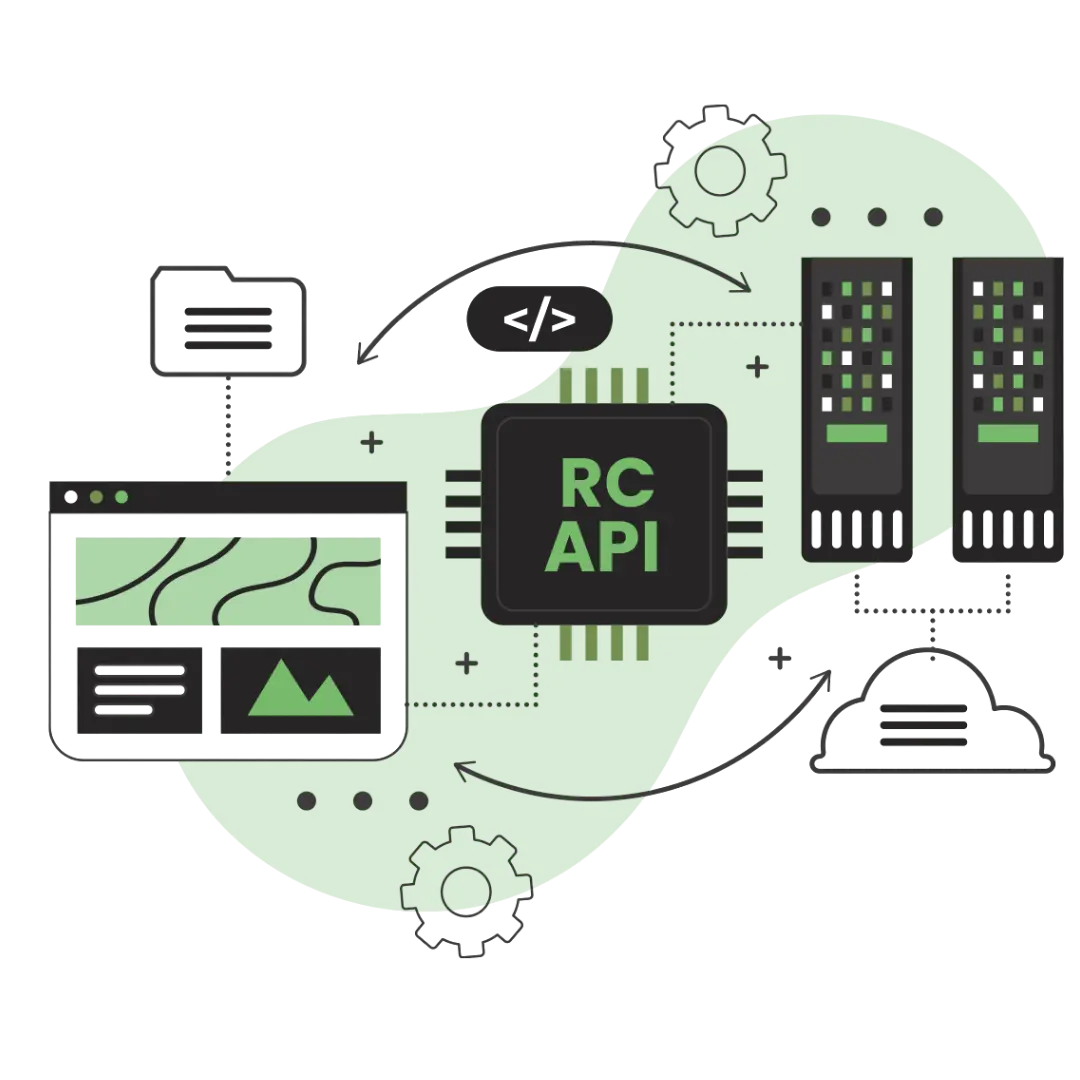
A Vehicle RC Verification API is a REST-based Vehicle Registration Verification API that retrieves a vehicle’s Registration Certificate (RC) details directly from VAHAN, the national vehicle registration database maintained by India’s Ministry of Road Transport and Highways (MoRTH).
Instead of routing a customer’s RC photo through a manual review queue, your underwriting or onboarding system sends a single API call with a registration number and receives structured, government-sourced Vehicle Data API output — RC status, ownership, hypothecation, and insurance validity — in under 500ms.
For compliance and risk teams, the distinction that matters is source: this is a Vehicle Ownership Verification pulled live from VAHAN under DPDP Act 2023 consent requirements — not a cached record or a third-party aggregation layer.
VeriCore's Vehicle RC Verification API queries VAHAN directly and returns a structured response your underwriting engine, KYC stack, or fraud model can consume immediately — with no manual review step in between.
- Vehicle owner name and registration number
- RC status (Active / Inactive / Suspended)
- Registration date and expiry date
- Vehicle make, model, body type, and fuel type
- Vehicle class and category
- Engine number and chassis number (masked per regulatory guidelines)
- Hypothecation / financing institution details
- Insurance company name and validity dates
- Fitness certificate status
- Permit type and validity
- Registering authority name, code, and state
Every field is sourced live from VAHAN — not cached records, third-party scrapers, or uploaded PDFs. What you receive matches the official RC document, validated at the source.
How VeriCore's RC Verification API Works
Submit a Vehicle Registration Number
A secure POST request to the RC Verification API endpoint with the registration number as the only required parameter. No image uploads, no OCR.
Real-Time Query Against VAHAN
Requests route directly to VAHAN, covering all Indian states and union territories. No cached dataset sits between your request and the source record.
Receive a Structured JSON Response
Owner details, RC status, vehicle specifications, insurance validity, and hypothecation status, returned in a versioned schema that stays stable across releases.
Automate Your Decision
Feed verified data into underwriting logic, onboarding workflows, or a fraud detection system without a manual handoff.
See the Actual Response
Send a vehicle registration number, get structured data back. No sandbox signup required to see the shape of the response.
curl --request POST \
  --url https://api.vericoreapi.com/v1/rc-verification \
  --header 'Content-Type: application/json' \
  --header 'X-API-Key: YOUR_API_KEY' \
  --data '{
    "rc_number": "MH02XXXXXX",
    "consent": "Y"
}'{
"success": true,
"status": "ACTIVE",
"data": {
"reg_no": "MH02XX****",
"owner_name": "R**** K****",
"rc_status": "ACTIVE",
"registration_date": "2021-03-14",
"vehicle_class": "LMV",
"maker": "MARUTI SUZUKI",
"maker_model": "SWIFT VXI",
"fuel_type": "PETROL",
"chassis_no": "MA3E****CP1****",
"engine_no": "K12M****234****",
"rto": "MUMBAI CENTRAL RTO",
"state": "MH",
"insurance_company": "ICICI LOMBARD",
"insurance_upto": "2027-03-13",
"hypothecation": "NOT HYPOTHECATED",
"fitness_upto": "2036-03-13",
"response_time_ms": 480
}
}Fields shown are illustrative. Actual field availability depends on VAHAN record completeness. Request full API documentation →
What Makes VeriCore's RC Verification Different
Pan-India Coverage
One integration covers RC data for every vehicle class across all states and union territories registered in VAHAN — private vehicles, commercial vehicles, two- and three-wheelers, and heavy motor vehicles.
API-First Design with Versioned Endpoints
REST conventions, versioned endpoints, and advance-notice deprecation windows — so a VeriCore update never silently breaks your integration.
Vehicle RC Verification API Built to Cut Fraud — Without Slowing Down Approvals
Confirm vehicle ownership and document authenticity before disbursing loans, issuing policies, or onboarding drivers — in the time it takes to load a page.
Manual RC Verification vs. VeriCore's RC Verification API
| Factor | Manual Verification | VeriCore RC API |
|---|---|---|
| Verification time | 4–24 hours | Under 500 milliseconds |
| Data source | Uploaded document (unverified) | VAHAN national database (authoritative) |
| Accuracy | Variable — depends on reviewer | Consistent — direct database query |
| Fraud detection | Limited — depends on visual inspection | Automatic — mismatch flagged instantly |
| Scalability | Linear with headcount | Unlimited — API handles load automatically |
| Audit trail | Manual — emails, spreadsheets | DPDP Act 2023–aligned consent capture and audit logging built in |
| Cost at scale | Increases with volume | Decreases with volume (tier pricing) |
| Integration | None — process-dependent | REST API — integrates with any stack |
| Compliance readiness | Difficult to demonstrate | Timestamp + response hash per record |
What Manual Vehicle Registration Verification Is Costing Your Team
Every day your team spends manually checking RC documents is a day a faster competitor is closing the deal you’re still reviewing.
Onboarding stalls behind document queues. Loan approvals wait on ownership that can’t be confirmed quickly. Operations stack up on RC uploads that might be tampered, expired, or simply wrong.
VeriCore’s Vehicle RC Verification API connects directly to VAHAN — the authoritative source for vehicle registration data in India — and returns verified, structured data in real time. No intermediaries. No cached records. No guesswork on your underwriting team’s part.
Whether you’re running ten verifications a day or ten thousand, this infrastructure is built to hold up at your volume. If vehicle identity, ownership, or registration status sits anywhere in your workflow, this Vehicle Verification API was built for exactly that job.
If your process involves any of the following, this page is for you:
- Confirming vehicle ownership and registration status before approvals or onboarding
- Validating RC validity, hypothecation details, and expiry dates
- Checking vehicle class, fuel type, and chassis data as part of due diligence
- Detecting tampered, expired, or mismatched RC documents before they create risk
Here’s what our RC Verification API eliminates from your process:
Here's what VeriCore's RC Verification API removes from that process:
Delays that compound.
A manual RC check that takes 4–6 hours doesn't just slow that one verification — it backs up every verification behind it. At scale, manual queues become the ceiling on how many customers you can onboard or how fast you can disburse.
Errors that cost money.
Reviewers misread registration numbers, confuse similar vehicle models, and miss hypothecation flags. These errors surface at the worst possible moment — a default, a fraudulent claim, a compliance audit — where the cost is far higher than the time "saved" by skipping the API.
Fraud that slips through.
Tampered RC documents aren't always visible to the eye. Edited PDFs, swapped photos, and forged stamps can pass a manual review. A database-connected check catches the mismatch instantly — the registration number either matches the official record, or it doesn't.
No audit trail.
Manual verification leaves no structured, DPDP-compliant record of what was checked, when, and under what consent. When a regulator or auditor asks, the answer has to be reconstructed from emails and scanned PDFs, instead of pulled from a clean, timestamped log.
Verify Any Vehicle RC in Under 500ms
Real-time RC checks powered by India's VAHAN database. No manual reviews, no uploaded documents — just instant, verified results.
Industry use cases
RC Verification API Use Cases by Industry
Built for every team that touches vehicles
Risk, compliance, and product teams across lending, insurance, and mobility use VeriCore's Vehicle Verification API to replace manual RC review with a single, auditable API call.
From loan disbursement to driver onboarding — see how Indian businesses use VeriCore's RC Verification API to eliminate manual checks and move faster.
Vehicle Loans & Auto Finance
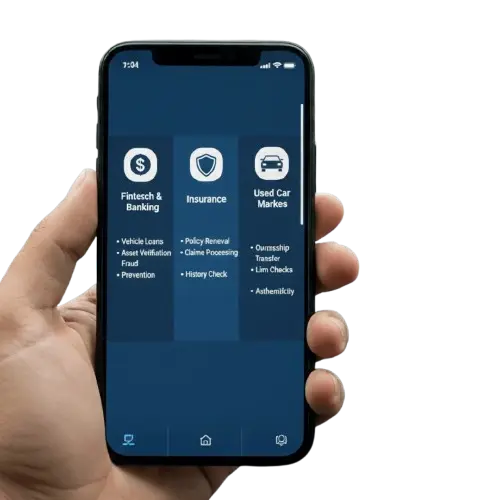
Before disbursing, lenders need to confirm the vehicle exists, the applicant is the registered owner, and no lien is on record. VeriCore returns all three in one call — owner name, RC status, and hypothecation, simultaneously.
Insurance Issuance & Claims
Motor insurers need verified vehicle data at two moments: issuance (to price risk and confirm registration) and claims (to confirm the claimant is the registered owner and the RC was active at the time of the incident).
Driver & Vehicle Onboarding
Ride-hailing and delivery platforms onboard hundreds of vehicles a week. VeriCore replaces the back-office photo-review queue — a driver submits their registration number, the API verifies it in seconds, and onboarding proceeds automatically.
Fleet Management & Asset Monitoring
Operators tracking hundreds of vehicles manually miss renewals and run expired registrations. VeriCore's batch API runs scheduled RC audits across entire fleets, flagging lapsed insurance, expired fitness, and ownership mismatches automatically.
Used Vehicle Marketplaces
A specific fraud risk in this category: sellers listing vehicles they don't own. An RC check at listing time confirms the seller is the registered owner before any buyer ever sees the listing.
KYC, Fraud Prevention & RegTech
RC data is a strong corroborating signal in identity workflows. A name mismatch between the RC and a submitted ID document — or an undisclosed hypothecation — is a reliable, instant fraud indicator.
Don't see your use case?
VeriCore works with any workflow that touches vehicle registration data. Tell us what you're building.
Vehicle RC Verification API Services — Pricing & Plans
Per-verification pricing scales down with volume — most teams run between 500 and 50,000+ verifications a month. Share your expected volume and we’ll get back to you with an exact quote within one business day.
All plans include sandbox access, API documentation, and standard support. Enterprise plans add uptime commitments, dedicated onboarding, priority support, and custom SLA terms.
Pricing is available on request — share your expected monthly volume and use case, and our team will respond within one business day.
Starter
Startups and early-stage integrationEnterprise
Banks, large insurers, fleet platformsWhy Vericore
Built for Vehicle Verification.
Not Retrofitted to It.
VeriCore’s schema, error handling, infrastructure, and audit tooling are built specifically for RC Verification API workflows — not adapted from a generic identity-check product.
Ready to integrate? Enterprise clients get dedicated onboarding — not just a docs link.
RC Verification API — frequently asked questions
A Vehicle RC Verification API Services provider is a company that retrieves a vehicle's Registration Certificate details from VAHAN in real time via a REST API, replacing manual document review with an automated, DPDP-compliant data lookup.
The terms are often used interchangeably. An RC Verification API specifically returns Registration Certificate data (ownership, status, hypothecation), while a broader Vehicle Information API may include insurance, challan, or fitness data as separate modules.
Auto lenders and NBFCs, motor insurers, ride-hailing and delivery platforms, fleet operators, used-vehicle marketplaces, and RegTech/KYC providers.
Owner name, RC status, registration and expiry dates, vehicle make/model/class, fuel type, chassis and engine number (masked), hypothecation status, insurance validity, and registering authority details.
By pulling data directly from VAHAN rather than an uploaded document, the API flags tampered RCs, mismatched owner details, undisclosed hypothecation, and expired records instantly.
Pricing scales with monthly verification volume, from startup tiers (500–20,000/month) to enterprise committed plans (20,000+/month with SLAs).
Yes — real-time single lookups, bulk/batch verification, and scheduled fleet-level RC monitoring are all supported.